


Naveen Singh KhadkaEnvironment correspondent
 Getty Images
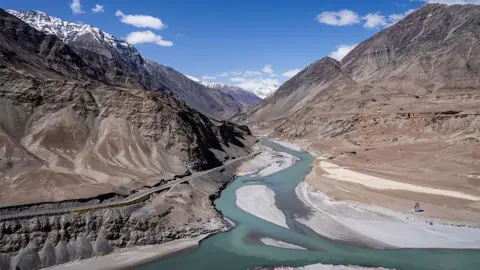
Winter snow is falling much less on the Himalayas, leaving the mountains barren and rocky in many parts of the region in a season when they should be covered in snow, meteorologists said.
They say most winters in the past five years have seen a decline compared to the average snowfall between 1980 and 2020.
Warming also means that less falling snow is melting very quickly, and some lower-elevation areas are also seeing more rain and less snow, which is at least partly due to global warming, according to the Intergovernmental Panel on Climate Change and other scientific reports.
Studies have also shown that there is now what is known as “snow drought” during the winter in many parts of the Himalayan region.
The accelerated melting of glaciers in the wake of global warming has long been a major crisis facing the Himalayan states of India and other countries in the region. Experts told the BBC that the decrease in snowfall during the winter makes matters worse.
They say the reduction in ice and snow will not only change the shape of the Himalayas, but will also affect the lives of hundreds of millions of people and many of the region’s ecosystems.
As temperatures rise in the spring, snow accumulated over the winter melts and runoff feeds river systems. Melting snow is an important resource for rivers and streams in the region, providing water for drinking, irrigation and hydroelectric power.
Aside from the impact on water supplies, low winter precipitation – rain in the lowlands and snowfall on the mountains – also means the region is at risk of wildfires due to dry conditions, experts say.
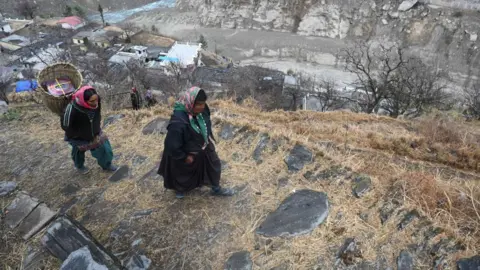
They add that vanishing glaciers and reduced snowfall are destabilizing mountains as they lose the ice and snow that act as cement to keep them safe. Disasters such as rockslides, landslides, glacial lake outbursts, and devastating debris flows are already becoming more common.
So, how dangerous is low snowfall?

 Unish Gurung
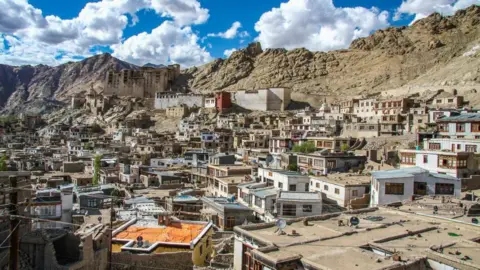
The India Meteorological Department recorded no precipitation – both rain and snowfall – across almost all of northern India in December.
The Meteorological Department says there is a high probability that many parts of northwest India, including the states of Uttarakhand and Himachal Pradesh, and the federally administered areas of Jammu and Kashmir and Ladakh, will see an 86% decline in rainfall and snowfall below the long period average (LPA) between January and March.
LPA is the rainfall or snow recorded over an area over 30 to 50 years and its average is used to classify current weather as normal, plus or minus.
According to the Meteorological Department, rainfall in north India between 1971 and 2020 was 184.3 mm.
Meteorologists say the sharp drop in rainfall is not just a one-time thing.
“There is now strong evidence across different datasets that winter rainfall in the Himalayas is indeed decreasing,” said Kieran Hunt, principal research fellow in tropical meteorology at the University of Reading in the UK.
A He studies Hunt, which he co-authored and published in 2025, included four different datasets between 1980 and 2021, all of which show a decline in rainfall in the western and part of the central Himalayas.
Using datasets from ERA-5 (European Center for Reanalysis of Medium-Range Weather Forecasts), Hemant Singh, a research fellow at the Indian Institute of Technology, Jammu, says snowfall in the north The Western Himalayas have declined by 25% in the past five years compared to a 40-year long-term average (1980-2020).
 Getty Images
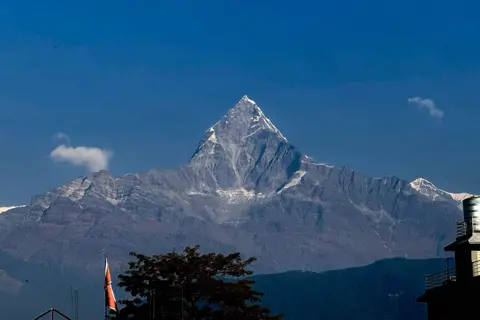
Meteorologists say Nepal, which lies within the Central Himalayas, also sees a significant reduction in winter rainfall.
“Nepal has not seen any rainfall since October, and the rest of this winter looks set to remain largely dry,” says Binod Pokharel, assistant professor of meteorology at Tribhuvan University in Kathmandu. “This has been more or less the case in all the winters over the past five years.”
However, meteorologists also add that there have been heavy snowfalls during some winters in recent years, but these events have been isolated and extreme and not the evenly distributed precipitation of past winters.
Another way scientists evaluate low snowfall is by measuring the amount of snow accumulated on mountains, and how much of it remains on the ground for a period of time without melting: what is known as snow persistence.
The winter of 2024-2025 saw a 23-year record low of about 24% below normal for snow persistence, according to a new report. a report By the International Center for Integrated Mountain Development (ICIMOD).
She said four of the past five winters between 2020 and 2025 saw continued below-normal snowfall in the Hindu Kush Himalayan region.
“This is generally understood to be consistent with reduced anomalies in winter rainfall and snowfall over a large part of the HKH (Hindu Kush Himalaya) region,” said Sravan Shrestha, Senior Fellow for Remote Sensing and Geoinformation at ICIMOD.
A He studies Singh with the Indian Institute of Technology Jammu, which he co-authored and published in 2025, shows that the Himalayan region is now increasingly experiencing snow droughts – where snow has become increasingly scarce – especially at altitudes between 3,000 and 6,000 metres.
“With snowmelt contributing about a quarter of the total annual runoff for the region’s 12 major river basins, on average, anomalies in seasonal snow persistence impact the water security of nearly two billion people across these river basins,” the International Center for Integrated Mountain Development snow update. a report warns.
Experts warn that melting Himalayan glaciers pose risks of water scarcity in the long term, while reduced snowfall and faster snowmelt threaten water supplies in the near term.
 Getty Images
Most meteorologists point to the weakness of the Western Disturbances – low-pressure systems coming from the Mediterranean that carry cold air – as a main reason for the low rainfall and occasional snowfall during the winter in northern India, Pakistan and Nepal.
They say that in the past, western disturbances brought heavy rain and snow during the winter, which helped crops and renewed snow on the mountains.
Studies are mixed: some suggest changes in Western unrest, while others find no significant shift.
“However, we know that the change in winter precipitation must be linked to the westerly disturbances, as they are responsible for the majority of winter precipitation across the Himalayas,” Hunt said.
He added: “We think there are two things going on here: the western disturbance is becoming weaker and, with less certainty, moving slightly north. Both are hindering its ability to pick up moisture from the Arabian Sea, leading to weaker rainfall.”
The India Meteorological Department has described the western disturbance witnessed in northern India so far this winter as “weak” as it may bring very nominal rain and snow.
Scientists may sooner or later discover the reason behind the decrease in winter precipitation.
But what has already become clear is that the Himalayan region now faces a double problem.
While it is rapidly losing its glaciers and ice fields, it is also starting to get less snow. Experts warn that this combination will have dire consequences.
Follow BBC News India on Instagram, youtube, X and Facebook.
