


Danish Prime Minister Mette Frederiksen speaks during a press conference at the European Union summit in Brussels, Friday, December 19, 2025.
Geert Vanden Weingart/AFP
Hide caption
Toggle caption
Geert Vanden Weingart/AFP
In a striking collective rebuke to President Trump, the leaders of Denmark, Finland, France, Germany, the Netherlands, Norway, Sweden and the United Kingdom issued a joint statement on Sunday condemning recent US tariff threats linked to their military actions in Greenland.
In the statement, the leaders of the eight countries affirmed their commitment to NATO’s common goals, saying they stand in “full solidarity” with Denmark and Greenland. They also reaffirmed their willingness to “enter into dialogue based on the principles of sovereignty and territorial integrity” in response to President Trump’s repeated threats to seize control of Greenland, which is currently an autonomous region of the Kingdom of Denmark.
On Saturday night, President Trump wrote on his Truth Social platform that he would impose tariffs on imports from the eight countries. Trump’s words came after NATO member states deployed military personnel to Greenland in recent days to participate in a Danish-led Arctic exercise known as “Arctic Endurance.”
Trump said that America will impose a 10 percent tariff on goods imported from the eight countries, starting on February 1. He claimed that these tariffs would rise to 25 percent on June 1, and would remain in place “until an agreement is reached for the full and complete purchase of Greenland” by the United States.
In their joint response, the eight NATO countries said that Trump’s proposed tariffs “undermine transatlantic relations and risk a serious deterioration.”
“As members of NATO, we are committed to strengthening Arctic security as a common transatlantic interest,” the leaders said. “The previously coordinated Danish exercise ‘Arctic Endurance’ conducted with the Allies responds to this necessity. It poses no threat to anyone.”
The coordinated statement reflects an unusually frank diplomatic response by key US allies. In addition, some European leaders issued their own individual criticisms.
British Prime Minister Keir Starmer condemned the use of tariffs against allies, describing it as “completely wrong.” A spokesman for the British Prime Minister later said that Starmer shared that view with President Trump in a phone call on Sunday. Swedish Prime Minister Ulf Kristersson said that Sweden would not be subjected to “blackmail,” while the Norwegian Prime Minister stressed that “threats have no place among allies.”
Danish Prime Minister Mette Frederiksen also made a statement praising the “great support” from European allies. “I am pleased by the continuing messages from the rest of the continent: Europe will not be blackmailed,” Frederiksen said.
European foreign policy leaders made clear that trade coercion would damage the broader transatlantic relationship and potentially derail other ongoing negotiations.
An unnamed French official close to Foreign Minister Jean-Noel Barrot told NPR that Paris had mobilized its diplomatic apparatus “to coordinate the European response to the new unacceptable tariff threats issued by President Trump.”
The official added that Barrow held talks with his British, German and European Union counterparts and was in contact with all relevant foreign ministers and political groups in the European Parliament.
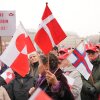
Ordinary citizens have also registered their opposition to President Trump’s recent threats, with large protests in Denmark and Greenland against US pressure coupled with broader NATO discussions on Arctic security as well as a diplomatic scramble.
In his social media post on Saturday, Trump framed Europe’s actions as part of a “very dangerous situation” and said the tariffs were necessary to protect “global peace and security” — language that European officials and analysts widely objected to as exaggerated or unfounded given the context of NATO cooperation in the Arctic.

This latest standoff over tariffs comes on the heels of weeks of increasingly assertive US rhetoric regarding Greenland and Arctic policy. Trump has repeatedly declared Greenland – a vast, sparsely populated region – of strategic importance to US national security, citing its location and untapped mineral resources.
The leaders of Greenland and Denmark have consistently responded, insisting that the region is not for sale, most recently during discussions between the two countries’ foreign ministers and Secretary of State Marco Rubio.
Domestically, the tariff decision sparked opposition not only abroad, but also among American lawmakers. Partisan voices in Congress have criticized this approach as damaging to NATO’s cohesion and warned that it could jeopardize US credibility.
Analysts point out that the United States already maintains a military presence in Greenland, which has diminished significantly over the decades, and therefore question the necessity of coercive economic measures linked to territorial ambitions.