


In the 4th century BC, at least four wooden boats were constructed on the island of Als off the coast of Denmark. The unknown attackers were routed, with the defenders sinking their enemies’ weapons into the swamp in one of these boats, known as the Hjortspring Boat, presumably to give thanks for their victory. Archaeologists have now carbon-dated and analyzed the caulking and rope material found with the boat, and have also discovered a partial human fingerprint found on part of the caulking material. This impressive footprint provides a direct link to ancient sailors who used the Hjortspring boat.
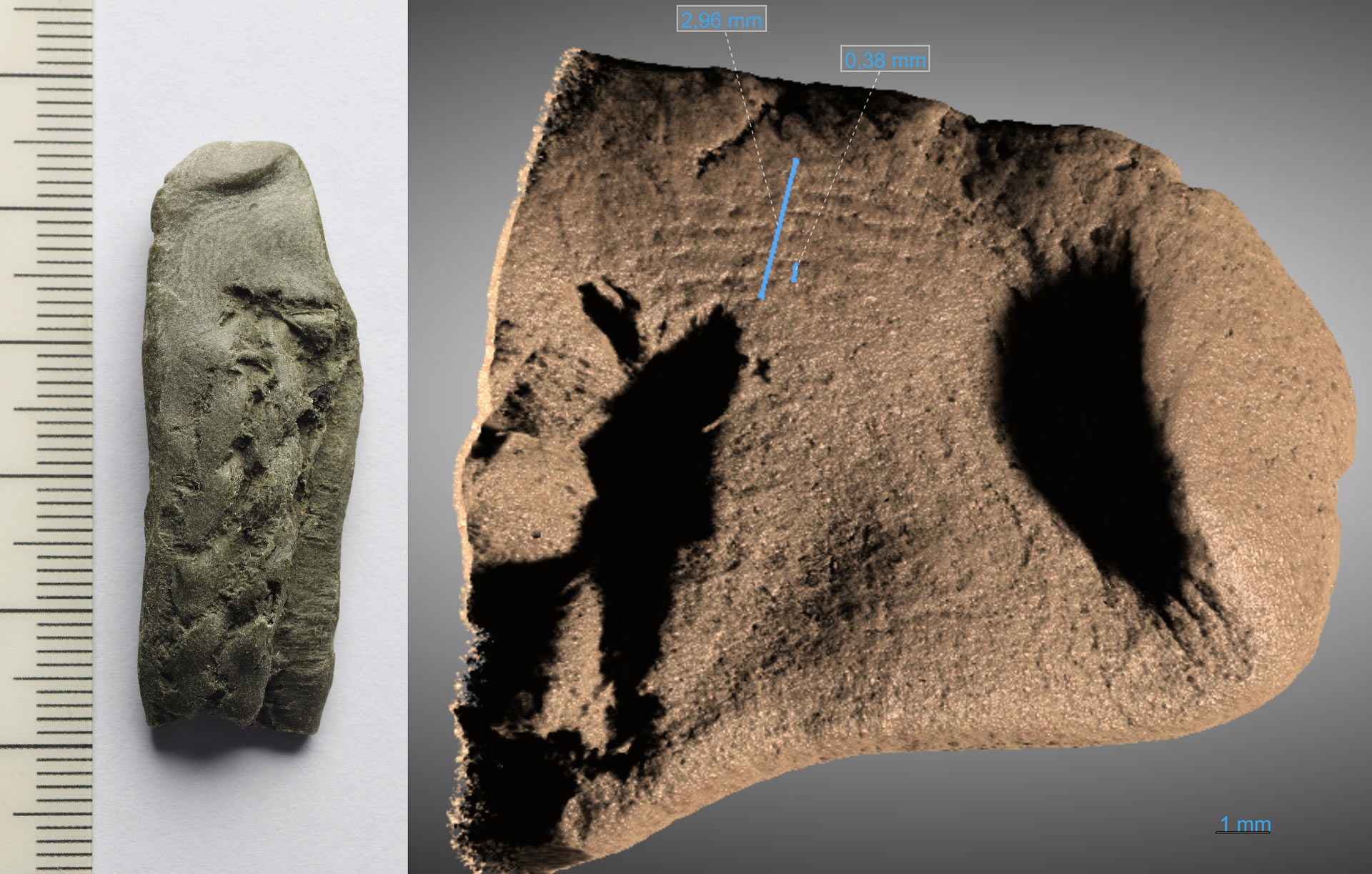
Image of part of the dam showing the fingerprint on the left and a high-resolution X-ray computed tomography scan of the fingerprint area on the right. Image source: Erik Johansson/Sahil Ganji.
The Hjortspring boat was discovered in the 1880s while digging peat in the Hjortspring bog on the island of Als off the southeast corner of Jutland, Denmark.
Official investigations into the discovery of the swamps and boats began in 1920 after the reunification of South Jutland with Denmark.
The boat was excavated by Gustav Rosenberg between 1921 and 1922 and about 40% of the original boat was recovered from the swamp, allowing the boat’s shape to be completely reconstructed.
Enough spearheads and iron armor were placed with the boat to equip a military contingent of about 80 warriors, far more than could fit inside the boat itself.
Based on these finds, it is suggested that a party from an unknown location traveling in up to four Hjortspring boats attacked the island of Als and were defeated, the victors depositing the weapons of their defeated enemies along with one of their boats in the marsh to give thanks for the victory.
After excavation, the boat was preserved and has been displayed in the Danish National Museum since 1937.
In the new study, Lund University archaeologist Mikael Fauvel and his colleagues carbon-dated and analyzed some previously unstudied caulking and rope materials found with the boat.
Using gas chromatography and mass spectrometry, they determined that the dam was likely composed of animal fat and pine pitch.
At this point in history, Denmark itself had few pine forests.
“It is possible that pine tar somehow reached Denmark through trade,” the researchers said.
“However, other coastal areas along the Baltic Sea, east of Denmark, had pine forests, which leads us to believe that the boat may have been built in these areas, and that it and its warriors may have come from that direction.”
“If this is true, the boat would likely have traveled a long distance over the open ocean to reach Als, which would indicate a remarkably organized and deliberate attack.”
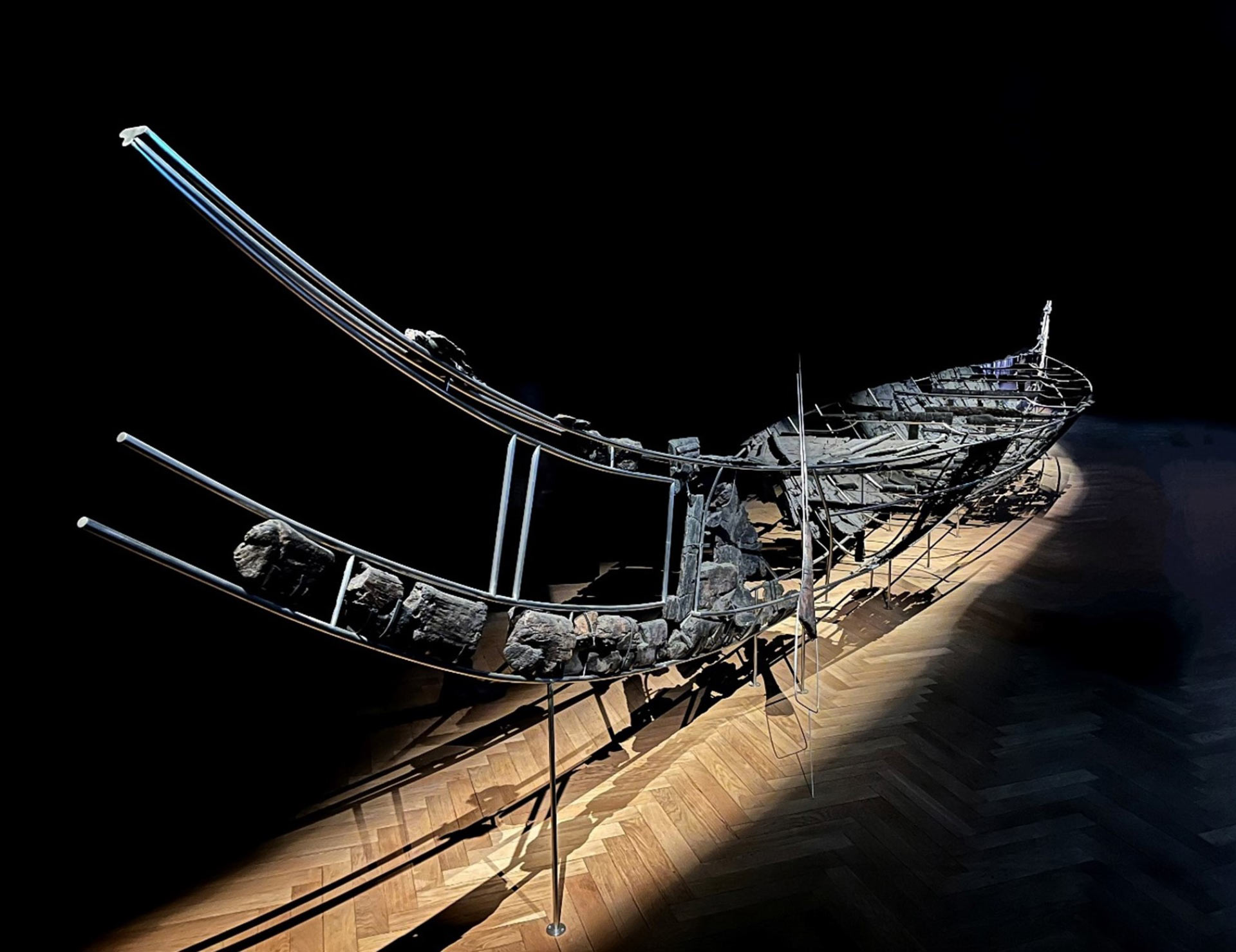
The Hjortspring boat as it is currently on display at the Danish National Museum. Image credit: Boyle Bengtson.
Carbon dating of the ropes and weir found that the boat was likely built somewhere in the 4th or 3rd century BC, which is consistent with earlier dates for the timber from the Hjortspring site.
In addition, scientists found a partial human fingerprint in part of the caulking material during the study.
While they were unable to determine exactly where this imprint came from, it is possible that a crew member left it while repairing the boat, providing a direct link to the ancient ship’s sailors.
“The new analysis of the oldest wooden boat in Scandinavia brings us one step closer to solving the mystery of the origins of the 100-year-old ancient boat,” they said.
“Using cutting-edge scientific methods, we focused on the Baltic Sea region as the most likely source for the approximately 2,400-year-old boat, while also discovering a fingerprint left by an ancient sailor in the tar used to protect the ship.”
“Finding a fingerprint on the tar fragments from the boat was a big surprise to us.”
“Fingerprints like these are very unusual for this time period.”
“It’s great to find a direct connection with someone who used this old boat.”
“The boat was used by a small army of invaders who attacked the island of Åles in southern Denmark more than 2,000 years ago.”
“The invaders were defeated and the local defenders sank the boat in a swamp as a show of thanks for their victory.”
“Since the boat was extracted from the swamp in the early 1920s, the question of where the invaders came from has remained an open mystery.”
“The weapons they used that were found in the boat were very common at the time and were used throughout northern Europe, which gives us a bit of a clue as to their origins.”
“Several different theories about the boat’s origins have been proposed over the past 100 years, with some scholars suggesting that the boat’s crew came from somewhere in northern Germany or perhaps from a different part of modern-day Denmark.”
“Now, our scientific analysis of the boat’s caulking materials gives us the first major new evidence in more than a century.”
“The boat was waterproofed with pine pitch, a rarity in both Denmark and northern Germany during the first millennium BC.”
“We see this as meaning that the boat and its crew most likely came from the east along the shores of the Baltic Sea where pine forests were more abundant.”
“The boat was excavated before modern dating methods were available and most of the material on the boat was immediately preserved using chemicals that make radiocarbon dating impossible.”
“But by going through the archives, we were able to find some original ropes that had not been preserved.”
“We obtained a radiocarbon date from the rope that returned a time range of 381 to 161 BC, confirming the boat’s pre-Roman Iron Age history.”
the He studies It was published online in the magazine One plus.
_____
Mr. Fauvel et al. 2025. New Investigations of the Hjortspring Boat: Dating and Analysis of Rope and Caulking Materials Used in a Pre-Roman Iron Age Wooden Boat. One plus 20 (12): e0336965; doi: 10.1371/journal.pone.0336965